The UN's Far-Left Anti-West Kangaroo Court
The ICJ's rulings are indistinguishable from those of a far-left student activist who hates the West: nuclear bans, Palestine action, imperial "decolonisation", and "climate change" enforcement. The UN orders one before it publishes ideology. The one-way direction of travel is always the same.
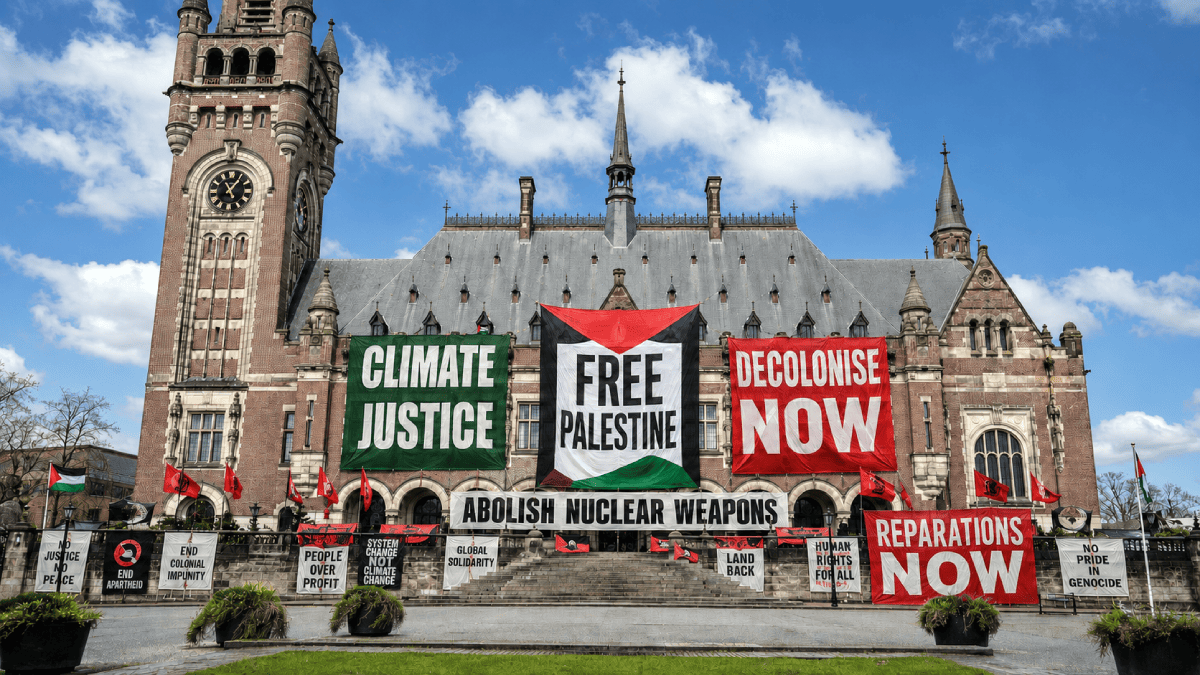
When you hear a politician say "the International Court of Justice", a certain picture assembles itself. Fifteen sober judges in a marble palace at The Hague. The principal judicial organ of the United Nations. A neutral referee for the quarrels of nations, standing above politics, applying the law without fear or favour. When it speaks, serious people nod. Governments cite it. Newspapers report its findings in the tone reserved for gravity itself.
That is, until one takes a closer look at this institution and what it actually decides. Its record tells a story the reputation is designed to obscure. Recently it was made painfully obvious as the "court" ruled on "climate change."
Like the UN itself, the "court" was built for one purpose and now performs another. It was meant to keep nations from each other's throats. It has become a body which, with striking regularity, produces the exact conclusions the international activist left would have written for it. It condemns the same handful of countries again and again, and never quite gets round to the others.
What The Court Was Built To Do
The ICJ opened in 1946, successor to a League of Nations court which had died with the League. Its brief was narrow and its founders wanted it narrow. States, and only states, could bring cases. And a state could not be dragged before it without agreeing to be there. Consent was the whole foundation.
A country had to accept the Court's authority before the Court could judge it. That single rule is what made an international court tolerable to sovereign nations rather than a weapon in the hands of whoever could assemble a majority against them.
This restraint was real, and for decades it produced results no campaigner would ever cheer:
- The Court protected Germany from lawsuits by Italian victims of Nazi crimes, ruling state immunity survived even atrocity.
- It shielded a serving Congolese foreign minister accused of grave crimes from a foreign arrest warrant.
- It turned away Ethiopia and Liberia when they tried to challenge apartheid South Africa, ruling they had no standing.
- It threw out the Marshall Islands when they sued the nuclear powers to force disarmament, on a dry procedural point.
A cautious institution, jealous of consent, wary of being made into a tool.
The fifteen judges are not appointed by some neutral college of jurists. They are elected, to renewable nine-year terms by the United Nations General Assembly and the Security Council. A candidate needs an absolute majority in both, which in the Assembly means 97 votes out of 193.
The West cannot muster 97 votes on its own and has not been able to for half a century. In plain terms, the same chamber which drafts the loaded questions also hands out the seats. A judge who hopes to be re-elected knows exactly whose favour keeps him on the bench. The UN is not neutral: it supports communist Cuba and hates nationalist Israel.
This is not a conspiracy. It does not need to be. It is simply an electorate, and electorates get the judges they vote for.
What the Court does now bears almost no relation to its cautious younger self, and the change runs entirely in one direction.
The Case With No Defendant
In July 2025 the Court delivered what was reported everywhere as a landmark. It ruled, unanimously, on the obligations of every state on earth in respect of "climate change.". Fifteen judges, one voice, the full authority of the so-called World Court behind it.
Ask the simplest question a court is supposed to answer first. Who was on trial?
Nobody. There was no defendant.
No state was accused, summoned, or given a charge to answer, because there was no charge and no accuser in any ordinary sense. The Court was not settling a dispute between two governments who had agreed to appear.
It was answering a question, posed in the abstract by the United Nations General Assembly, about what states owe when their emissions harm the climate and what they owe to the vulnerable and the unborn.
The mechanism is called an advisory opinion, and it is the quiet trapdoor beneath the Court's whole reputation. The ICJ was built on consent, so no nation can be judged without agreeing to it.
The advisory opinion is how that rule gets switched off. The General Assembly asks a question in general terms, no defendant is named, and so no defendant's consent is required. The Court answers. The answer is formally non-binding, and then every court, campaigner, and government on the correct side of the argument cites it as settled law for the next fifty years.
The effect is a conviction without a trial.
How convenient.
Britain and the United States and the other large emitters never agreed to have their energy policy judged by fifteen foreign jurists. Under the old rule they could not have been.
Under the advisory route they were condemned anyway. In a proceeding with no defendant, no consent, and a plaintiff who never had to name them. The reputation says neutral referee. The mechanism says something closer to a court which has learned how to try you in your absence.
Motivated Reasoning: Start With The Answer To Work Back To The Question
There is a detail about the climate opinion which no amount of solemn reporting quite conveys, and it is almost comic once you see it.
The whole thing started as a university project.
The tiny ex-British state of Vanuatu (population 335,000) adopted the campaign, assembled a coalition, and steered a resolution through the General Assembly asking the Court the question. Six years later the students had their answer, in full, unanimously, from the Peace Palace. Several judges added notes complaining only the Court had been too timid.
The question they got the Assembly to ask was not neutral. It wasn't merely the contentious topic of "climate change," but the left-wing extremism of "climate justice."
It asked what obligations fall on states which "have caused significant harm to the climate" and what they owe to those "injured" and to "future generations". The guilt is assumed in the wording. You do not ask a court what the guilty party owes unless you have already decided who is guilty, and everyone in the room knew the answer was the industrial West.
The moment the ruling landed, Vanuatu's climate minister said he would take it straight back to the General Assembly to pursue a resolution "to support implementation of this decision". He called the opinion a "shield and sword". Not a finding. A weapon, described as one, cheerfully.
Result: everyone has to write Vanatu a cheque now. Because it's an island, and something about magic climate woo-woo.
The scam has all the makings of a profitable racket.
The Assembly, where the West is permanently outvoted, wants an outcome. It votes to ask the Court a question engineered to produce that outcome. The Court, staffed by a legal profession which shares the Assembly's instincts, obliges. The Assembly then waves the answer about as the neutral verdict of "international law" and passes the policy it wanted all along.
The politics writes the question, picks the plaintiff, elects the judges, and waits at the door to collect the judgment it ordered.
This is not a court informing policy. It is a court manufacturing the legitimacy policy could not win at the ballot box, in any national parliament, or in the treaties themselves. The advisory opinion sits upstream of the resolution, and the resolution was always the point.
The themes are not a random assortment. Line them up and they read like a manifesto anyone could recite from a Marxian sociology degree or a socialist party booklet:
- "Decolonisation" and the guilt of empire.
- "Climate justice" and reparations from rich nations to poor.
- The dismantling of Israel's position at every turn.
- Nuclear disarmament.
- Duties owed to "future generations" and to a vaguely defined "international community" which no citizen ever elected and no treaty ever created.
- Redistribution from the developed world to the developing, recast as legal obligation rather than political preference.
These are not the neutral concerns of a referee. They are the settled priorities of the contemporary international left, and the Court has adopted them as its own working assumptions.
Power Grabs Hidden Under Jargon
Buried in the climate opinion is a phrase which sounds technical and means something enormous. The Court ruled that a nation's climate pledges are no longer a matter of sovereign discretion but of judicially reviewable adequacy.
Translated: your elected government may no longer decide for itself how far and how fast your country cuts its emissions. It can propose a figure. Whether that figure is good enough is now for judges to determine, measured against a temperature target the same profession has declared legally binding. Fall short and you are in breach of international law.
Setting a country's energy policy, weighing the cost of heating a pensioner's home against the cost of "decarbonising", balancing jobs and industry and the price of power, is among the most basic tasks of a government answerable to its own voters.
The Court has quietly moved judgement from the elected to the appointed, from the ballot box to the bench.
Your vote still decides who proposes the number. Fifteen jurists you did not choose and cannot remove decide whether the number passes.
And the penalty for failure is not abstract. The opinion treated the 1.5°C target as binding, attached duties of finance and technology transfer running from the developed world to the developing, and opened the door to compensation for historic emissions.
Reparations, in effect, under a gentler word.
The UN wants to redistribute the West's wealth to the Third World. The Court was used to produce a legal basis for it using whacky, unproven Marxist hypotheses about the supposed environmental harms of industrialism.
For a neutral referee, that is a remarkable amount of legislating.
Britain Has Already Been Through This Machine
If the climate case shows the mechanism in the abstract, the Chagos case shows it stripping a specific country of specific territory, and that country is Britain.
The British Indian Ocean Territory is a cluster of atolls whose largest island, Diego Garcia, hosts one of the most important Anglo-American military bases in the world. In 1965 Britain separated the archipelago from the colony of Mauritius shortly before granting Mauritius independence. Mauritius agreed at the time and took the compensation.
Fifty years on it wanted the islands back and ran into the old wall. It could not sue Britain, because Britain had never consented to have its sovereignty judged.
So the trapdoor was used again.
The General Assembly asked the Court an advisory question about the "legal consequences" of the 1965 separation.
The "legal consequences" are simple. It was ours, we agreed to Independence, and you agreed and took the cash. Nothing to see here.
Reframe a sovereignty claim as a decolonisation grievance and the consent requirement disappears. Which is handy for the Chinese and their influence on Mauritius.
In essence, it did the same trick. Start with the conclusion; work backwards to the question. The UN wanted to set policy, so it employed the "court" to legitimise its politics in advance, as cover. The UN calls it Britain's "last African colony."
In February 2019 the Court ruled 13 -1 Britain's continued administration of the Chagos was an unlawful act which had to end "as rapidly as possible". The Assembly endorsed it 116 to 6 and gave Britain six months to leave. The five countries willing to stand with Britain were Australia, Hungary, Israel, the Maldives, and the United States. Everyone else wanted the map redrawn.
The Court decided all this in the name of self-determination, the right of a people to choose their own future.
Which people did it ask? Not the Chagossians. The islanders had been expelled from their homes in the early 1970s (a genuinely shameful chapter of British conduct), and the Court never enquired what they wanted. They were treated not as a people but as a territorial detail belonging inside the colonial unit of Mauritius.
A doctrine built on the will of a people ignored the only people actually on the land, because their wishes did not fit the answer. Self-determination turned out to mean the wishes of a government a thousand miles away in Port Louis. The islanders were scenery.
That is how the reasoning works across the board. It is not the destination. It is the costume worn by a conclusion arrived at first.
The Same Faces Keep Appearing
An institution supposedly above politics turns out to be run, argued, and staffed by a fairly small and fairly like-minded professional class, and once you notice the recurring names the neutrality gets harder to credit.
A prominent example is the barrister who led Mauritius to victory over the UK.
Philippe Sands, a traitorous British KC, spent more than a decade building the legal strategy which stripped his own country of the archipelago.
He was refreshingly candid at the time about the method, conceding the same facts could be a bilateral sovereignty dispute or a decolonisation question, and arguing decolonisation simply trumped sovereignty. Which is to say the trapdoor was not an accident of the case. It was the strategy.
The same traitor lawyer has spent years pressing the climate-justice cause; helped draft a proposed international crime of "ecocide"; co-founded an environmental-law pressure group; and backed the Vanuatu campaigns. One man, threading decolonisation, climate reparations, and the expansion of international criminal liability through the same handful of courtrooms. He is not unusual. He is the type.
Sands is a question for domestic opinion. In any sane world his polite treason would rightly mean the rope. If sanity returns, it should.
Even the sympathisers noticed the awkwardness of the Chagos result. A group called Chagossian Voices pointed out Mauritius, the supposed victim of colonialism whose cause the Court championed, was itself administering the islands from a thousand miles away and had never properly represented the actual islanders. The people in whose name the case was won were, once again, absent from it.
Then there is the bench itself.
Its recent advisory work has not been the product of a so-called "Global South majority" steamrolling reluctant Western judges. The climate opinion was unanimous, and the judges who signed it included nominees of the United States, France, Germany, Australia, and Japan. The Chagos verdict against Britain went 13-1.
The uncomfortable truth for anyone hoping this is merely bloc voting is the Western judges are not resisting the drift. They share it.
The doctrines which turn activist wishes into binding law, obligations owed to all states, evolving custom, the rights of the unborn, are the common language of the entire profession from which the judges are drawn. And they are elected by an Assembly which likes the language very much.
A Straight Line Of Far-Left Activism
There is a reason the United States wants out of this court and out of the ICC. Take the Court's big politically charged advisory opinions of the last thirty years. Strip out the Latin and the paragraph numbers. Then ask whether the demand left standing differs in any way a normal person could detect from a protest banner at a Palestine Action rally on the same subject.
| The Court's advisory opinion | The banner outside | The finding, in plain terms |
|---|---|---|
| Nuclear Weapons, 1996 | Ban the bomb | States must disarm; use generally unlawful, one grudging survival exception |
| Israeli Wall, 2004 | Tear down the wall | Barrier in occupied territory unlawful, dismantle it |
| Chagos, 2019 | Decolonise now | British rule unlawful, end it rapidly |
| Palestine, 2024 | End the occupation, reparations now | Presence unlawful, withdraw rapidly, evacuate settlers, pay reparation |
| Climate, 2025 | Make the polluters pay | Binding duties, differentiated burden on the West, compensation opened up |
The direction never varies. Where the banner shouts "make the polluters pay", the Court murmurs "state responsibility and compensation". Where it reads "decolonise now", the bench prefers "complete decolonisation as rapidly as possible". Same instruction, quieter voice.
For an institution whose entire authority rests on standing above the fray, it has a curious habit of landing precisely where the placards are. It always seems to land where a lunatic student at Cambridge with dyed hair and a massive library of neo-Marxian literature might also find themselves.
The single honest exception proves the rest. In 1996 the Court could not quite bring itself to outlaw nuclear weapons in every case, because it baulked at telling a nation to accept its own destruction.
A campaigner would call it a cave-in to the nuclear powers, and by the logic of every other opinion, it was. It is the one time the Court's nerve failed the activist line, and it failed only when the alternative was national suicide.
Never In The Dock: China, Russia, Islam
If the pattern were only about which causes the Court favours, it might be waved away. The harder fact is about who ends up accused, and who never does.
In the dock, over and over:
- Britain, over Chagos.
- Israel, over the Wall, the "occupation," and Gaza.
- The developed Western economies, over historic emissions.
- The United States, over Nicaragua and over its sanctions on Iran.
- The Western nuclear powers over disarmament.
A guest list of remarkable consistency.
Never troubled at comparable scale:
- China, over the mass internment in Xinjiang or the subjugation of Tibet.
- Russia, over the largest surviving empire on the planet.
- Turkey, over its half-century occupation of northern Cyprus.
- Indonesia, over West Papua.
- Morocco, over Western Sahara, a case legally almost identical to matters the Court has pursued with real energy when the accused was Western.
Not one of these has produced anything like the same body of judgments with the same political and structural consequences.
The standard defence is this simply reflects which cases can reach the Court; which treaties contain which clauses; who has consented to what. It sounds reasonable but it does not survive a second look, because deciding what to drag before the Court is itself the most political act in the whole business.
The General Assembly picks the advisory questions.
Coalitions of states pick the contentious cases.
And the picking runs one way with the reliability of a compass needle. The Chagos question was posed because a bloc wanted Britain embarrassed. The climate question because a bloc wanted the West billed. The Wall and occupation questions because a bloc wanted Israel condemned.
The Court does not go looking for these fights. It has simply never been known to turn one down.
The Alibi Of The Boring Cases
The Court's defenders keep one reply in reserve. Most of the ICJ's work, they say, is dry and genuinely even-handed. Maritime boundaries. Diplomatic premises. Frozen assets. Decided on the law, no politics in sight.
Quite true.
And quite irrelevant.
Nobody organises a movement around a fishing boundary in the Gulf of Fonseca. The cases which shape international argument, i.e. the ones cited in parliaments and printed on banners, are the advisory opinions which have pointed one way for twenty years.
Citing the dull cases to excuse the loaded ones is like praising a newspaper's crossword to change the subject from its front page. The crossword is fine. The front page is where the trouble is, and the front page is where the Court now does its most consequential work.
When the ICJ arbitrates a real quarrel between two states who both agreed to appear, it can still behave like a court, and frequently does.
When it acts as the General Assembly's advisory chamber on the great political questions of the day, it behaves like an unelected legislature.
It answers questions written by governments who already knew the answer. It condemns states who never agreed to be judged. It consulted students and ignored islanders. And it hands the result to the very coalition which ordered it, to be waved about as law.
Does Britain Owe This Court Anything?
The honest description of the modern ICJ is not a subtle one. On the questions which matter, it functions as the litigation arm of a political programme, The programme is the familiar one carried by student unions, activist NGOs, and the permanent majority of the General Assembly.
- Empire was a crime for which the West must still pay.
- The rich nations owe reparations to the poor, dressed as climate duty.
- Israel is always in the wrong.
- Sovereignty yields whenever sovereignty protects a Western state, and hardens whenever it shields anyone else.
This is not the cautious internationalism of 1945. It is campus politics in a wig, and it has learned to issue its slogans as though they were law.
The trouble is the slogans arrive with real consequences attached, because the Court sits upstream of the machinery which turns them into policy.
An advisory opinion is not the end of the process. It is the raw material. The General Assembly commissions the ruling, the ruling is handed down, and the ruling is then cited back in the Assembly, in national courts, in treaty negotiations, and in the domestic law of any government looking for cover, as the settled voice of international justice.
What no elected parliament would pass and no honest treaty would contain is smuggled in through The Hague and laundered into obligation. Britain's own courts and civil servants are already being told the climate opinion binds the country's hands on energy. That is not a court keeping the peace between nations. It is a court writing the rules those nations never agreed to.
Britain is a law-abiding country and takes its international commitments seriously, and that instinct is precisely what is being exploited. A nation which honours its word can be steered by anyone willing to dress a demand in legal costume.
The Chagos surrender was the demonstration. Britain handed over an ocean territory, and the strategic base on it, not because a treaty required it or a war was lost. But because a body it had helped to build told it to, and the reflex to obey outran the question of whether obedience was deserved. The intellectual answer is one part; the real answer is: absolutely no, go away, we are a nuclear-armed state.
Honour paid to an impartial court is a virtue. Honour paid to a partisan one is merely a lever in someone else's hand.
None of this argues for lawlessness. Britain should keep its genuine treaty obligations, pay its debts, respect real judgments in real disputes it agreed to submit. But obligations do not trump statecraft or national interests.
When the ICJ resolves a bounded quarrel between two consenting states, it deserves the respect owed to any arbiter. When it manufactures worldwide duties in a proceeding with no defendant, no consent, and a plaintiff chosen for effect, it deserves the response any sovereign nation gives to a foreign pressure group. It can be heard. It need not be obeyed.
The World Court was given one task in 1945. Keep the great powers from each other's throats. Somewhere in the decades since it decided the more gratifying work was sitting in judgement over them, and it discovered the easiest country to judge is the one which still mistakes it for neutral.
Britain can go on paying tribute to such a mistake, surrendering territory and policy on the word of a chamber which would never rule the same way against its enemies. Or it can notice, at last, the referee has been wearing the other side's colours for some time and decline to keep playing as though the whistle were fair.